Showing posts with label Pickup trucks. Show all posts

Tuesday, February 8, 2011

Finding Inspiration in Altercation

I have now started four different posts in the last week. They are all in various forms of completed, yet I am completely incapable of finishing a single one.

This may be writers-block. It may be Seasonal Affect Syndrome. It may be my own mental degradation leading to an eventual psychotic break down where I lose all ability to think function or use punctuation whatsoever

But I doubt it.

This is a basic mind-over-matter situation. Or is it matter-over-mind? My mind is saying,

“No! Your ideas suck. Your abilities suck, Your ability to drive and automobile sucks!”

Even when the universe is against me, I am determined to prove myself wrong.

When the World is Against You, Drive a Big Truck

I got home today a little before 6pm. Annie had class late, so I was excited to change out of my dress digs, leash up Ellie for a brisk walk in the frigid night air, and then settle in for some literary grunt work. I pulled into the lot, trekked up to my second level apartment, and expected to find a little dog, anxiously awaiting my arrival in the kitchen, where I'd left her. I fumbled for the keys, turned the lock, and flipped the switch in the kitchen. As I looked around the room, I found my dog nowhere in sight. I did, however, find the barricade blocking her into the kitchen pushed open. My dog was laying comfortably on my bed.

What a rascal.

After our walk, I decided that it was time for a new gate for the kitchen doorway. I loaded the pooch into the truck, and headed to the store. What was supposed to be a quick trip to Walmart ended with no baby gate. They had ultra-amazing, state-of-the-art, laser-sighted baby gates. They had extra-tall gates for your behemoth babies. But they had no regular old safety gates – the wooden kind that slides back and forth along the notched wood and inevitably gets stuck two inches short of the length you want it to be. So I left Walmart empty handed.

On the way back to the apartment, I pondered where else I might get a gate. I could always go across town to the other Walmart, or Target or Kmart or any of the other department stores in town. As I was weighing those options, I saw Walgreens up ahead. Now there's a novel idea. Walgreens has a bit of everything. They may just have what I'm looking for.

I pulled in and put the truck in park. Commanding Ellie to stay, I dismounted, and headed into the store. Moments later, I exited, sans gate. I clambered back into the truck, resolving to find my dog gate another day. I had writing to do, so I needed to get home. I glanced over my shoulder and began backing out of the spot, cranking the steering wheel to the right. Suddenly I felt a jolt through my system as the truck impacted something behind me. I slammed on the brake, threw the transmission into park, and jumped out to assess the situation.

As I rounded the back of the truck, I was met by a frantic woman pacing back and forth as if bouncing off of imaginary walls.

“I can't believe this! I can't believe this! I know I should have gotten the rental insurance. My car's in the shop, so this is a rental...It's not even mine! I can't believe this!”

As I looked the two cars over, I found the truck unscathed. The back bumper of the woman's Dodge Charger however, did not fare so well. The rear driver side corner was shattered where it had made contact with the truck. She'd pulled her car back into the space she was back from, allowing room to walk between the vehicles. In an effort to calm her down, I said,

“Well, it seems as though we both are at fault here...seeming as though we were both backing out at the same time. There isn't any damage on my vehicle, so I'll leave it up to you – do you want to call the police, exchange insurance?”

She opted for all of the above. I called 911 and explained the situation. Then we sat in our vehicles and waited.

And waited.

And waited.

I could feel my writing time disappearing as I sat, listening to underground musicians on Iowa Public Radio. The longer I waited, the more irritated I got. Irritated at the police for their tardiness. Irritated at the woman for not seeing my truck. Irritated at the dog for breaking out of the kitchen, prompting this whole endeavor in the first place. I was just irritated in general.

To Swerve and Protect

Finally the police arrived. I hopped out and approached the car. Upon request, I began proffering up the details of the incident. As I began explaining how we were both backing up and collided, the woman from the car piped up,

“Hey wait a second. No, no, no. That ain't how it happened.” I was just parked here, and he backed into me. I hadn't moved from my spot.”

The irritation that had been simmering in me flashed into unbridled aggression as I processed what she was attempting. The two sides of my brain grappled between my desire to explode in a flourish of epithets about the low-lifed, underhanded, nefarious nature of her snake like words and the more logical side that realized a public outburst such as the one I wanted to perform would lead to more serious police involvement. In the split second I took to weigh my options, the public servant in the car before me interjected,

“It doesn't matter what happened. Your on private property, so we will not be determining fault. Give me your insurance cards and licenses and I'll issue an exchange of information report.”

I was relieved that the officer had stepped in to quell the brewing discourse. But I was also terribly agog. I could not believe that this woman was trying to pin this thing on me! I went back to my car and sat, broiling in the frigid night air. I cranked the heater of the truck, and stared at the red car in my rear-view mirror. As I sat and went over the details again and again in my mind, I began analyzing the scene from every angle, every perspective. I would be damned if this woman tries to throw me under the bus on this. It was her fault for not looking before backing out of the space!

Eventually the officer came to my truck, gave me the report, and wished me luck with the insurance companies.

I finally staggered into my apartment around 8:30pm. After three wasted hours of gate-less gallivanting, I'd made it home. I didn't even feel like writing. Curse you, powers that be! You've sucked all the desire to create from my body! I just wanted to watch syndicated Seinfeld while dissolving into my lumpy futon. Against all desire, I opened my computer.

As I sat, exhausted, staring at the blank screen of my computer, I tried to write. I opened all of the half written blogs that had been swirling around my brain. I typed a word here, a paragraph there. But I had nothing. The universe had sucked me into another doldrum of creative drought. But then I realized it. In stopping me from writing, the universe failed to realize that it'd given me something better. It gave me fodder.

It was hard at first, convincing my brain, rusted with exhaustion, to began cranking again. But as I slogged through the first few paragraphs, it became easier. And soon enough, I'd retold the whole story.

So next time you get writers-block, for God's sake, stay in the house. It's much safer that way.

Wednesday, January 5, 2011

Father Hoenig - A Pastoral Tale

Have you ever met a person that, upon looking back, defies all logic? I'm not saying that the person makes illogical decisions, I am referring to the idea that their very being does not compute in your brain? This is the case with Father Hoenig.

I don't know Father Hoenig's first name. Though he was a priest, I've never attended a service he's officiated. I've come to learn of this priest through a professional relationship.

It was a sweltering hot afternoons in early August. It was late in the day, when the sun starts balking at the earth, sending shadows long but refusing to give up it's tenure of torturous heat. At the shop of Leroy Walljasper, we were all befuddled by some persnickety machine that had been commissioned for repair. As we stood back viewing the machine with a contemplative simmer, a little truck rattled into the drive.


Peculiar Pastor

The truck, if it had to be identified by one make or model, would be a Nissan, although the one remaining bumper, hood, and passenger side door would beg to differ. Most of the body used to reflect a navy blue hue, but it had oxidized to the point that a burnt orange crust overwhelmed any color on the trucks once gleaming hull.

The vehicle paused for a moment, unsure as to whether it would lurch forward from it's clutch or give up life indefinitely. Instead, it coughed to a dilapidated halt under an old hickory tree across the lot. Then, slowly and unsteadily, Father Hoenig tottered into view from behind the rusted out machine.

An immaculate version of Father Hoenig's jalopy
He was wearing black dress shoes that had long shirked the title “dress”. They were missing their laces, allowing the tongues to flap wildly as his legs jerked unnaturally out in front of his body. Inside the shoes were fathers naked feet, untethered by socks in the summer heat. He wore navy blue slacks, one leg caught around his knee in the style that LL Cool J made famous in the 80's and 90's. Hoenig's black shirt was unbuttoned but half tucked into his slacks, one shirt tail flapping in the breeze, the other bunched and stretching the cloth across his thin hunched frame. The white priestly collar was sticking out of the neck of his shirt, bouncing with fervor as his shoulders lurched ever closer to the shop.

Father Hoenig's hair was ghostly white, almost as if a wispy milkweed plant had landed on the back of his head and had clung there, ever so meekly, being tousled by the winds of that summer afternoon. One of the man's eyes drooped uselessly to the side, as if it'd jump free of its housing, if the skin surrounding the orb would only relinquish its grasp. I'd later learn that this useless eye was struck blind from complications of diabetes. At the time, however, it was simply one more element of absurdity in a whole collection of flesh and bizarre.

“I've got a mower. It...it...stopped working.” the monsignor said meekly as he approached the group of us who'd been observing his pilgrimage across the gravel. His voice was small and shaky, as if he was still working on shaping them as the passed his lips. They reached us with an upturn, making every word a milquetoast inquisition. As my grandfather questioned the elderly man, the story began to appear, but only in small sections. With a long drag from his cigarette, grandpa said through a puff of smoke,

“Yeah father, we can probably get that running 'gain for ya. Bring it by tomorrow and we'll get to workin' on it.”

“God bless you. Thank you. Thank you...so much. God bless you son, for helping me with my...mower.” Father tottered back across the rocky lot, clambered into his pickup, and sputtered into the distance, leaving naught but a plume of white gravel dust in his wake.

“I hope he realizes that I'm still gonna charge him for the thing. Blessings don't keep the lights on, ya know?”


Mowing the Unmowable

The next day, one of the fellas that helps Father Hoenig around the farm brought by the mower. He dropped it off and, tipping his hat, wished us luck.

As we dug into the machine, we found an incredible mess inside. From the looks of it, the mower had been run against something so hard that it not only stopped the blades from spinning, it actually took the alloy shaft that runs the length of the machine, and turned it into a corkscrew. This made our job immensely more difficult. After a few hours of driving the blades off the shaft with a sledge hammer, we retreated to the office to regroup against the twisted adversary. Grandpa lit a cigarette, grabbed a coke from the pop machine, and grabbed the phone.

“Yeah, this' Leroy. What the hell'd he do to this thing? Well, it's twisted up tighter'n a tax collector.”

Grandpa listened for a few minutes, then let out a chuckle. Shaking his head, he imparted the account.

Father Hoenig had a lot of land that, in recent years, he'd either forgotten about, or chosen not to plant for some reason or another. Whatever the reason, he'd remembered these fields on that particular summer and, upon inspection, decided that they needed to be cleared. The easiest way to do that was to hook on to the hay mower and cut through the ragweed and canadian thistles. It should only take a couple hours with this new mower. He was cleaning up the land pretty well, until he ran up against something, stopping the machine dead in its tracks. Rather than investigate this issue, he backed up the tractor, lifted the mower, and came back to the house. When his farmhands went out to inspect, they found what had stopped the machine so abruptly. It was an old moldboard plow.

A possible equivalent of Father Hoenig's adversary
It's not small. It's not unnoticeable. Even with shoulder high weeds and brush, most people would see a plow from the tractor. Most people with two good eyes. Unfortunately, I don't think father had one good eye.

The plow had done substantial damage to the mower, and the project was not fun. A week later, we'd finally gotten everything back in working order for father. He came back to pick up the cutter, and graciously paid grandpa, with a check as well as a blessing.

Curious, I asked grandpa why he called him 'Father'. Was he really a priest? I'd never heard of a priest who was also a farmer, but then again, I'd never met a character like Father Hoenig.

“Yeah he's a retired priest, lives out by Montrose. Used to be the pastor at St. Joe's out there, till they forced'm to retire. Still says a mass or two every now'n again. I guess it's a site.” Grandpa went on to recount the foibles he'd heard. Stories of Father Hoenig asking the altar servers what part of the mass came next, or speaking so quietly and unintelligibly that no one was sure whether they should sit, stand, sing, or kneel. It wasn't uncommon for Father to be late for mass, or forget to show up at all. For that reason, he hasn't been saying many masses any more, which is fine by him, as it gives him more time to farm.

I haven't heard much about Father Hoenig in recent years. I don't know if he's still farming, still driving, or still alive. While I may have depicted him as weak or unstable, I assure you that he was one of the most venerable individuals I met working at Walljasper Construction. He refused to give up, even when it meant pitting himself against 19th century farm machinery.

To this day, I'm not sure I understand Father Hoenig. He was truly an anomalous entity. But maybe that was what is so intriguing.


Tuesday, December 7, 2010

Keep on Trucking

There is just something I love about driving a truck.

Please put the above statement in context. I drive a 2008 Toyota Matrix. A gunmetal gray hatchback that gets an average of 34 mpg. I love my car. I love everything about my car. It is the perfect vehicle for my life – living, working, and playing in a midsized metro area.

But when I recently drove my father's 2005 Ford F-150 Lariat quad-cab pickup truck, every logical reason for owning a sub-compact, fuel-efficient Toyota went out the window. The car fulfills every logical need I have for vehicular transportation, but the truck meets a more inherent, philosophical need. If you were to compare the two vehicles:

Toyota Matrix

Compact
Great handling
Easy to get in and out
Fold down seats create additional cargo room
Fuel-efficient
Sits low to the ground – little wind resistance

Ford F-150

It's friggin' huge
Takes corners like a boat
You need a rope to pull yourself into it
Its a truck. It has a bed. What other cargo room do you need?
Fuel? What is fuel? This thing goes through it like water
You'd be closer to the ground riding a giraffe

Every Girl's Crazy 'bout a Pickup Man

It may be a deep-seated masculine impulse, or it may be something I learned growing up in a farming community in Southeast Iowa. Trucks are the gold standard in Lee County and trying to find a Toyota, Honda, Suzuki, or Hyundai dealership within one hundred miles of my old country home is near impossible.

In high school, I would drive my little auction bought 1993 Mazda truck to school, and squeeze into a spot between any variety of giant 1980's Chevy or Ford truck. Mud tire clad, lift kit jacked, PA system blaring, aftermarket Cherry Bomb straight pipe exhaust ripping through the sonic atmosphere, these behemoths of the Central Lee High School parking lot would roll through the rows like prowling lions, daring a smaller car to cross their path. The 454 big-block engines would roar out a warning to the lesser vehicles, lest they be crushed under wheel like the tin cans they were.

My truck? It was a wounded meerkat. Stay out of the way, and I'd be fine. Otherwise my little red rice burner* would be a little red rice cake.

A Truck of a Different Color

The truck got me through high school. In college, my Mazda went kaput and I inherited a 1985 GMC Grand Sierra from my grandfather – a loaner that served me well for the rest of my higher education. At Monmouth College, where the student body is largely comprised of suburban Chicago minds, I encountered a very different vehicular phenomenon.

As the country mouse among city mice, my truck signified a tough agrarian existence. My newly-acquired “farm boy” image was further heightened when I cut the shoulder-length hair I'd sported throughout high school. My summer job working for my grandfather's farm implement sealed the deal, as I proudly wore my WALLJASPER CONSTRUCTION hat throughout the school year. I'd somehow gone from the hippie/punk kid driving a little foreign clunker in high school to the down-home country boy sporting the hulking pickup in college. I cannot really qualify this change in perception as good or bad, but it was certainly an interesting realignment of reality. Over the next few years I wore my agrarian heritage on my sleeve as something that made me stand out at Monmouth.

That old GMC would go on to be featured as a part of the ZBT homecoming float, haul pianos, drums, and more than its fair share of students, and cart all of my personal possessions to my new home in Davenport, Iowa.

But as all things are cyclical, my life would lead me back to a foreign vehicle. The GMC didn't do well for my wallet as I zipped around the Quad Cities on sales calls. So I sent it back to the farm, where it could be free to roam as God intended.

And I bought a Toyota. The more responsible choice.


*I apologize for the potential political incorrectness of the term rice burner as a pejorative synonym for an Asian made vehicle. This term is common vernacular in Southeast Iowa, where an American owned car company was held in much higher regard than any foreign made vehicle.

Tuesday, November 9, 2010

Put Your Patience in the Corner


In high school I bought an old fixer upper pickup truck at an auction. I have fond memories of the old beater, despite the fact that it sat defunct more often than it ran. When it did run, the heater worked in fits and starts, the acceleration was horrible, due in part to the fact that the carburetor was on it's last leg, and the radio was stuck on the same talk radio station.

Over the five years I had the old red Mazda, I replaced the entire fuel system, planed the head and replaced the head gasket, and finally removed the entire engine in an attempt to fix a damaged crankshaft. I learned a great deal about automotive repair over the course of that truck's life. I also lost my cool a number of times. One afternoon in particular, I was replacing the fuel tank in the old clunker which, on paper, should have been a fairly quick process. I was in my grandfather's tool shed, squirming around on the dirt floor while manhandling the 50 pound tank around struts, fuel lines, and electrical conduit. From the colorful language spewing out of my gritted teeth, an onlooker would have though I was wrestling a cougar underneath the bed of the truck. Reaching an impasse, I shimmied out from under the chassis, threw down my pliers, kicked the truck, and stormed towards the door. My grandfather, who'd been observing the entire display of frustration, stopped me with a wise hand,
My Patience out of the Corner

“Now Chris. Put your patience in the corner.”

I spun around, still in a pestilent fury. My emotions were still enraged at the obstinate vehicle, but my mind reeled as it tried to wrap itself around this bizarre phrase.

“What the hell does that mean, grandpa?!?”

As it turned out, the phrase was something my great grandfather, Lawrence, would say to grandpa when he was in a tempestuous fervor. When stopping and thinking about the incipience of the word, grandpa was as taken aback as I was.

“I don't know what it means, It's just something he always said to me. Put your patience in the corner.”

Whatever its history, the phrase served its purpose. It got me out of the emotional, illogical state I was in and got me back into that cerebral, analytical frame of mind in which I needed to be. I was still pissed at the truck, but at least now I could look at the problem objectively. I got back to work and soon had the tank installed.

The phrase has come back a number of times as I've worked on projects with my grandfather, though now it is as much a running joke as it is a true quip of wisdom. I still don't know where the term originated. Neither does the internet, or at least not Google. Whatever the reference, it is a phrase that will surely live with me, and probably be imparted onto my children in times of anxiety and vitriol.

I've long thought that the phrase would work well in a song, but I've never been sure of how to work it into the music. Then this came to me a few weeks ago. Call this song an homage to my Grandfather – Leonard Bernard Stephen Overberg - a man who's by all means fallible, but works hard and does his best with the life that's been given to him. One hell of a man.

Put your Patience in the Corner

Lennie Stevens is a friend of mine
Imparts his wisdom over dandelion wine
Hands like tree roots and a farmers tan
Lennie works hard. Lennie is a hell of a man

Born in the heartland, Midwestern drive
Lennie's spent his whole life working to survive
He trades his dollars for tractors and grain
When I ask him why, he just smiles
then he explains

Wherever you're going, wherever you've been
You've always gotta try your best but your always gonna sin
So when you stumble, when you lose your cool
Put your patience in the corner and it'll see you through

Lennie Stevens is a God fearing soul
puts on his suit coat and he sits in the front row
Folds up his hands as he pleads with the sky
If you ask him why he prays this will be his reply

Wherever you're going, wherever you've been
You might get dealt a hell of a hand, that you just cant win
So when you hate the world, you don't know what to do
Put your patience in the corner and it'll see you through

Wherever you're going, wherever you've been
You've always gotta try your best but your always gonna sin
So when you stumble, when you lose your cool
Put your patience in the corner and it'll see you through


What do you think Put your patience in the corner means? Share your explanation, and maybe together we'll figure it out.

Friday, October 22, 2010

A Side-Splitting tale of Medical Marvel

I worked several jobs to get through college, both during the summers and while in school. The most consistent employment was the three year tenure I held at Walljasper construction, my grandfathers Vermeer baler implement. I never had an official title, but in practicality, it ranged from office manager to baler technician to farm hand.

Sporting a Walljasper Construction hat
I inventoried parts as they came in. I built hay mowers, rakes, and tedders like they were giant Lego sets. I serviced balers that stood fifteen feet high and spit out six foot round bails from their pneumatic maws. They were like giant jungle gyms for adults – the only differences being that this playground was equipped with giant roller bars that, if not properly restrained, could crush me like a corn flake, and generally I was required to scramble across its surface wielding a blowtorch and a hammer, the only tools capable of breaking free the ball bearings we commonly replaced. Every day was different, every task brought on a new challenge that generally led to a string of curse words that were common vernacular around the shop. There was a particular eight word expletive stream that flowed so easily from the mouth, it seemed to be the standard expression of complete frustration among men of my family. Any timidity I had when I first entered this job was soon lost as I smashed fingers, ran over toes, caught my hair, or banged my knee. Couple these mild injuries with the healthy dose of uber-machismo heckling I received from everyone save my grandfather, and I quickly learned that it was better to shut my mouth or let forth an exasperated fray of flower wilting utterances than to whine about the ailments that befell me.

The characters I met during my summers at the shop were among the most peculiar bunch I will ever encounter. Many of them lacked the book knowledge I was so proud of attaining as a sophomore in college, and I looked down on them for it. I thought that they were inferior for their ignorance. But what many of the farmers I met lacked in philosophical know-how, they made up for in honest labor and experiential wisdom. They knew more about the land they worked and the crops they harvested than I'll ever know about any one subject. They knew more about the weather than any meteorologist, and any one of the men I met in those ungodly hot Iowa summers could jury rig a broken down piece of machinery in a field a hundred miles from nowhere with some baler twine, a pair of pliers, and a can of chain lube.

The summer after my Sophomore year of college, I resumed my post in the shop, just in time for prime baling season to hit in mid May. Not three months earlier, I began dating a Junior at Monmouth College, the girl who would later become Mrs. Chris Walljasper. Before leaving school, we agreed that Annie would come down from suburban Chicago to visit and meet my family. She had experienced limited agrarian life, and was excited to meet my grandparents, learn about where I grew up, and see where I worked. So one sultry summer afternoon, she embarked upon the journey.

Annie was supposed to arrive a few hours after I got off work, giving me ample time to clean up before seeing her. In her excitement to be reunited with her new love, she showed up about three hours premature, discovering me at the shop, elbow deep in baler chains and grease. It was an amazing surprise, and I was ecstatic at the sight of my future wife, dressed like a million bucks and there just to see dirty ol' me.

She cutely attempted to help me on the baler for a few moments, but we soon realized that this was not the best idea, considering her polished attire. I sent her into the air conditioned office, where I would soon be finishing the day out before going home. I assumed that this would be the best place for Annie. Evidently, I was mistaken.

When I completed the repair on the machine, I joined my girl in the office, only to find that she was being entertained by an unintentional yet eccentric guest. And appearances were not as they seemed.

A farmer, who's name I'll leave out of this anecdote, had come by the shop office while I was busy, wanting a part for his hay mower. The man was honestly one of the nicest guys who worked with my grandfather, but did not come across as an incredibly learned man. The cleft pallet that divided his upper lip was the main culprit in giving our agrarian friend the appearance of a less than philosophical personality. He was never incredibly concerned about his attire, which on that particular day, was composed of a blue vented cap, a flannel button down shirt, a pair of shabby gray sweat pants, and Velcro strapped shoes. This was particularly slovenly for the farmer, but none of these characteristics, by themselves, were enough to be a cause for concern.

The thing that had Annie's jaw on the ground was the fact that one of the mans arms appeared to be firmly planted inside his jersey trousers, dangerously close to what she logically concluded were his genitalia. Upon entering the office, I strolled to the pop machine, grabbed a soda, and meandered to the counter before realizing that Annie was shooting me desperate looks as she feigned interest in whatever the farmer was chatting about. Mr. hand-in-pants, not phased by Annie's look of utter horror at the evident impropriety, kept talking, chatting away as if nothing was amiss.

I cordially assisted the man, providing the parts he'd come in for, and after he left, burst into laughter. I knew exactly what Annie had been thinking, and couldn't wait to hear what she had to say.

“What was that man doing?!? His hand was...it was...Was he, TOUCHING HIMSELF?!?!?!”

Picking myself off the floor, I wiped the tears from my eyes and began to explain the bizarre story of our one armed friend.

The man owned a Model K baler. It was a newer vintage, equipped with an additional piece of equipment on the tail of the machine that, upon completion of a six foot round bale of hay, would administer a cellophane like wrapping around the circumference of the bale. This feature was the pride and joy of Vermeer, but after a few months of constant use, the rollers that conveyed the net wrap would collect remnants of the polyvinyl product and eventually stop the wrapping process. When this happens, it is recommended that the farmer bring the machine to the implement, where a technician could service it. Our farmer did not heed this advice.

I do not know the specifics of the incident, but evidently, the baler jammed up, so he hopped off the tractor to see what was the matter, and, finding the net wrap rollers incapacitated, took out his trusty pocket knife and began whittling away at the clog. This would have been a perfectly acceptable remedy, had the PTO been disconnected and the roller halted. But that was not the case. In seconds, both of his hands were caught by the spinning cylinder and forcibly run through the machine. At this point, I personally would have passed out. The grizzliness of this event is enough to make my stomach churn even now. But for his lack of foresight, this guy was tough. He retrieved the dismembered pieces of his opposable digits and made it across the field to his truck, where he proceeded to drive over ten miles back to his home, where his wife then escorted him to the hospital. Through all the pain and blood loss, he remained cognizant and focused enough to attain the medical attention necessary. But this isn't where the story ends.

The practice of reattaching a persons severed digits, then sewing them into the abdomen is evidently not common, as everyone who I've told this story to has been either appalled or dumbstruck. The technical term is Autografting, transferring flesh from one part of the body to another. By inserting the reattached thumb into his stomach, the healing properties of the abdominal cavity promoted blood circulation and nerve regeneration. To its credit, the unorthodox procedure resulted in a fairly successful use of his hand, when everything was said and done.

I explained all of this to Annie, who was dubious, to say the least. Upon verification from several other members of my family, she was finally convinced. I wouldn't believe it either, if I hadn't seen it myself. 

The miracle of modern scientific ingenuity prevailed to save this mans ability to hold up the underside of a sandwich for another day.

Tuesday, October 19, 2010

Pistols to Plowshares


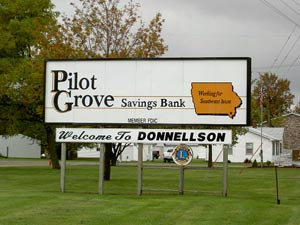
I was listening to an excessive amount of William Elliot Whitmore a few weeks back. Whitmore always gets me feeling reminiscent for home and a more agrarian life in southeast Iowa. Now my childhood in Donnellson, Iowa was no where near a country life. Residing in a town of 946, resplendent with baseball fields, a city park, and a public pool, I was seen as a soft city kid. I didn't raise animals, save the cats and dogs we kept as pets. I didn't learn to operate heavy machinery until I was in high school. I didn't hunt, ride four wheelers, or drink Busch Light at the age of 14.

My home town
But compared to the students I met in college from Chicago and St. Louis, or the thespians and artists I work with in Davenport, I am as country as an ear of corn. The handful of years I spent on my grandparents farms has made me a certifiable agricultural specialist in the circles I run. That and a healthy dose of bull shit.


So I was driving home from work, listening to NPR (that's the city boy in me), when I heard a sponsorship PSA for an organization called Plowshares institute. The name is derived from a scripture in the book of Isaiah,

“They will beat their swords into plowshares and their spears into pruning hooks. Nation will not take up sword against nation, nor will they train for war anymore.”


As I mulled over the idea of Swords into Plowshares, I attempted to update the metaphor.

Plant the Piece

Bombs into plowshares
Guns into plowshares
Pistols into plowshares

That had a great ring to it. As I rolled the words around my brain, a story began to develop. A Jesse James style tale of misdeed and a fight for survival for a young country boy. A little dramatic, maybe, but perfectly in style with the over-the-top affectations of the early westerns by John Wayne, Gary Cooper, and Errol Flynn. From that story, this song arose. Here it is.


Pistols to Plowshares

I was born in the dust bowl, in the fall of '21
Grew up corn and cattle, my old man, and his shot gun
Saw my pa gunned down in cold blood over debts we could not pay
I took everything that meant anything to my pa and I rode away

Trailed him home that night, on my dads horse with his shot gun
Buried two shots in that bankers back, and in the dead of night I run
15 year old fugitive, I gunned my way cross the midwest
Lookin for some answers, praying for some rest

Now I been running longer than I've been sitting down
looking over my shoulder, so I don't end up in the ground
And all I want is a plot of land, a place to lay my head
Turn these pistols into plowshares, find some peace before I'm dead

I met a girl in Iowa, on the day I turned 16.
Took her out a dancing, I sure did find her keen.
But some ol' rounder cut in on us, he'd seen my face and the word reward
Lit up that ol' dance floor, left my lover on the floor.

Now I been running longer than I've been sitting down
looking over my shoulder, so I don't end up in the ground
And all I want is a plot of land, a place to lay my head
Turn these pistols into plowshares, find some peace before I'm dead

My old man never taught me much before he left this earth
The value of a good mans word, what a hard days work is worth
The only thing he didn't teach is how its bigger to forgive
If he had I wouldn't be here now just struggling to live.

Now I been running longer than I've been sitting down
looking over my shoulder, so I don't end up in the ground
And all I want is a plot of land, a place to lay my head
Turn these pistols into plowshares, find some peace before I'm dead

As always, post any thoughts, comments, additions, etc.


Thanks for listening! See you next week.

Friday, October 8, 2010

The Fight or Flight Dichotomy


I am not a violent man. I have to say that, if confronted with a physical altercation, My first impulse would be to run for my life. It's a survival instinct. I've always been skinny and unassuming, so it seems like the logical choice. But in recent years, an alternative impetus has begun to emerge.

I almost came to blows with a large man in an F-350 extended cab today. He tried to turn in front of me as I was passing through an already precarious intersection, and almost decimated my wife's Prius. Having already had a stress filled day, I'd had enough. As he screeched to a halt across the nose of my hybrid, I laid on my horn and shook my fist while my wife gestured irreverently. From the navy blue cab emerged a huge black man. His head was shaved, his face contorted into a menacing grimace, and his t-shirt could hardly contain the overflow of muscles packed into his arms. He loomed over the roof of the pickup with a scowl that could have bore a hole in my forehead. The behemoth began his march around the bed of the truck, towards my Toyota, and everything slowed to a crawl as I began to assess the situation. I was so livid that this man dare cut me off, let alone think he had the right of way. My initial reaction was to reach for my seat belt, go toe to toe with this linebacker of a man, and explain to him the traffic laws of our great state. He would see that he's fucked with the wrong skinny white dude today, and he'd get back in his truck and drive away.

Instead, as the surly giant lumbered out of his vehicle, Annie broke me from my paralysis with a commanding,

“Chris? Drive. NOW!”

With that, I snapped out of my daydream of virility and laid on the accelerator, getting as far away from that meathead as I could. My rational pacifism had returned to save my neck again. But will this sense of chivalry and physicality return again?

It seems that in the past five years or so, there has been an almost carnal impulse to defend, confront, and retaliate using force. In the past, I'd never consider it, as my self-esteem was fairly low, and my ability to envision a fist fight that didn't result in my bloody remains on the sidewalk was nonexistent.

When I was in the seventh grade, I played soccer. Our team was good, as middle school soccer teams go. We even won the district championship that year. But practices were rough. One teammate in particular made it his goal to push, poke, prod, and provoke me to the breaking point. And one day, while waiting in line for a drill, he succeeded.

He'd been punching me in the arm, repetitively, for about ten minutes. Small, consistent blows to the same spot on my dilapidated deltoid. Finally, I couldn't take it any more, and I pushed him away. I swung back my arm, my hand balled up in a little round clump of fingers and knuckles, loosely organized into a fist and let loose the hardest, most devastating blow possible. It landed on the bully's shoulder, then bounced to a rest at my side. I checked to see the result of my fury, and found only mirth and condescension. More out of shame than the physical pain he had inflicted, I began to tear up, so I ran to the locker room to avoid any further torture.

That incident had a lasting impression on my fight or flight instincts. Maybe it is the film industry that makes me feel that I've slacked in my ass kicking duties as a man in this country. Maybe, as I grow more comfortable with who I am, I will continue to stop people from pushing me around.

Whatever the reason, I've found myself appealing to fisticuffs other times as well. There was a time when my cousin and I went to a local bar in the Quad Cities to get a beer and watch a band we'd heard about. We got there and Adam went to the bar to get some drinks. After a while, he returned irritated, no drinks in hand. Without an ID, it seemed, the bar tender was unwilling to chance serving alcohol to a minor.

I then went up and got a beer. They eyed me suspiciously, as they'd seen me with Adam. After a few moments of enjoying the music and conversation, Adam got up in a huff, irritated by something.

“This is bullshit. I'll be right back.”

I watched him approach the end of the bar and begin what appeared to be a heated conversation with the bartender. Soon two gigantic men entered the discourse, at the behest of the server. It looked as if they were about to forcibly remove my cousin from the premises. That is when I realized that I had a filial duty to become involved and protect my family. As I approached the discussion, my mind went to the movies, where one person gets into a fight at a bar, and his friends are obligated to jump into the fray and bail him out. I came to the meeting with my nerves steeled, anticipating the worst. I stepped into the circle and asked Adam, in a tone that made it evident I was here for support,

“Is everything alright here?”

Adam then explained to me these gentlemen had been giving him threatening looks from across the bar, and that he would not stand for being treated in such a reproachful manner. He demanded they leave him alone. It needs to be said that my cousin is a bit more tempestuous than I, and does not have a problem flaring up in the heat of the moment. While I cannot attest to the validity of his argument that night, and I did not relish the idea of getting my face turned into ground hamburger, part of me was ready to step into the fray and offer a valiant attempt at coming to my friends defense.

Luckily the conversation calmed down, and we left the bar unscathed. But this is one more incident that leads me to wonder if I am somehow hardwired to a visceral desire for expressing this physical dominance. The feeling is by no means pervasive, but it does seem to flourish in times of extreme adrenaline rush. Is this brought on by something inherent, or is it something that is merely a product of the media, my learned response to “what a man should do when faced with a conflict”?

I am no more physically capable of defending myself in a brawl than I was in the seventh grade, save being a few feet taller. But maybe my change in self awareness and perception of the world over the past decade has given me this new aggression towards those who've caused me injustice. I don't know if I'll ever use it, but knowing it's there, somewhere in my core, is comforting.

So don't think you can push around us scrawny little white guys. We may look nerdy, but who knows what kind of fight we have inside.